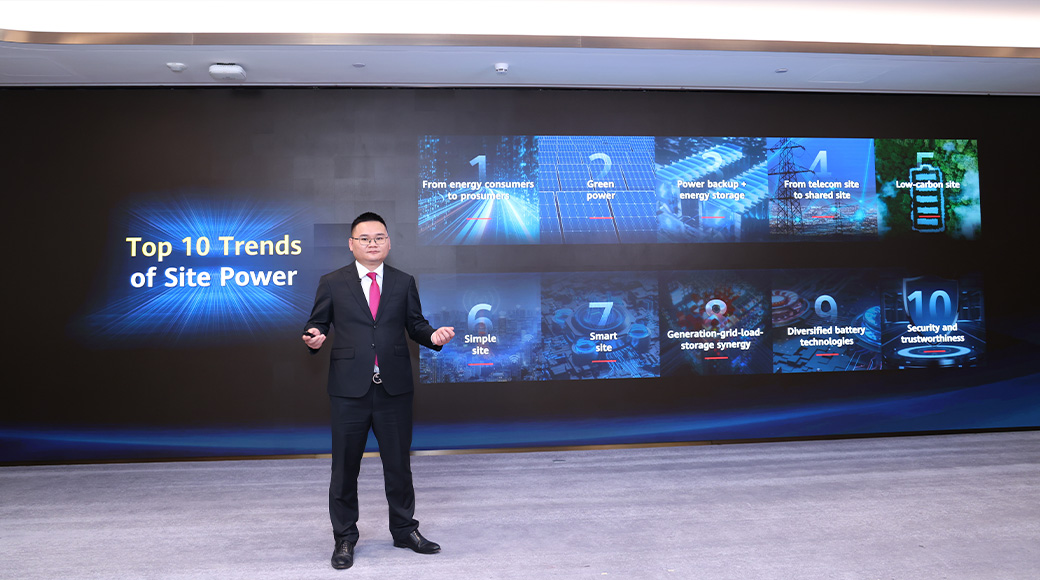
[Bangkok, Thailand, May 9, 2024] The
8th Global ICT Energy Efficiency Summit, themed "Green Site, Building a Brighter Future", was
successfully held in Bangkok, Thailand. Communications industry standards organizations,
industry associations, leading operators, and solution providers, including International
Telecommunication Union (ITU), Global System for Mobile Communications Association (GSMA), AIS,
Zain, China Mobile, Smart Axiata, Malaysia Universal Service Provision (USP), XL Axiata, and
Huawei Digital Power, delivered keynote speeches at the summit to explore the path of green
network transformation by exploiting the value of ICT energy infrastructure.
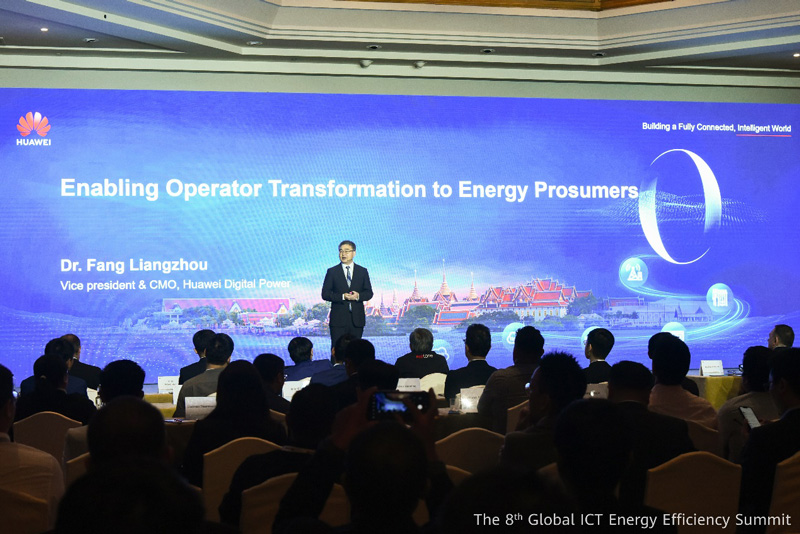
From Energy Consumers to Prosumers, Enabling Operators
Succeed in the Era of Carbon Neutrality
At the beginning of the summit, Fang
Liangzhou, Vice President and CMO of Huawei Digital Power, addressed that Huawei Digital Power,
by integrating digital and power electronics technologies, delivers customers with products and
solutions in fields such as clean power generation, green ICT energy infrastructure, mobility
electrification, and integrated smart energy.
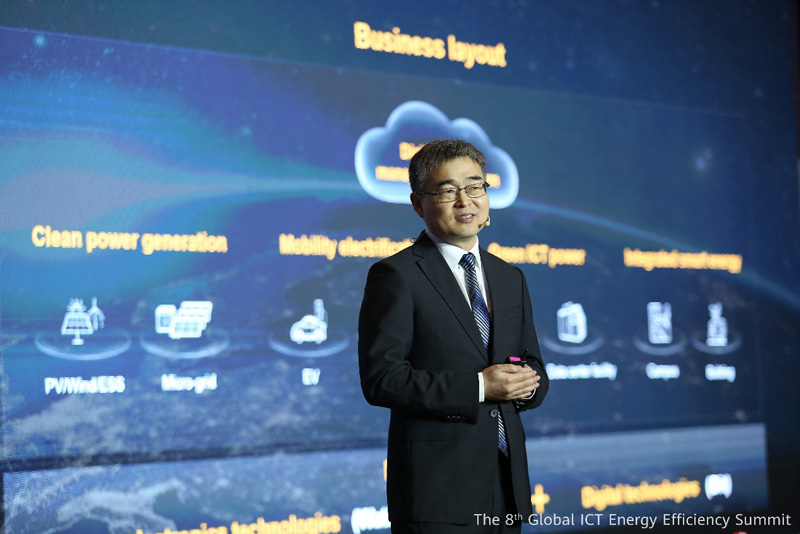 Fang Liangzhou, Vice President and CMO of Huawei Digital Power
According to Mr. Fang, despite the
urgency of emission reduction and the soaring energy expenditure in the ICT energy sector,
operators can make full use of their energy infrastructure, including physical sites and power
resources, and introduce innovative renewable energy technologies and solutions to expand their
business boundaries, transitioning from energy consumers to prosumers.
-
Green power generation at sites: There are
about 7.5 million physical telecom sites around the world. As the PV levelized cost of
electricity (LCOE) continues to drop, distributed PV systems deployed at sites with good
sunlight conditions can achieve well closed-loop business. This not only saves
electricity costs, but also helps gain green power benefits.
-
Participation of energy storage at sites in power
market auxiliary services: Owing to the scaling up of global clean energy,
the demand for power market auxiliary services, such as peak shaving and frequency
regulation, is on the rise. And as the core infrastructure for power market auxiliary
services, energy storage resources witness a growth in their value. To support
communications services, operators have deployed large-scale energy storage resources,
based on which we can use intelligent technologies to realize more functions such as
peak staggering and virtual power plant (VPP) regulations instead of power backup only,
thus diversifying the value of sites.
In addition, electric vehicle (EV)
charging facilities can be built at existing sites, contributing to global mobility
electrification. Green development has become a global consensus. Operators should follow the
tide of energy transformation and join the global zero-carbon action to secure success in the
era of carbon neutrality.
Site Power Target Network, Facilitating Operators to Build
Green and Low-Carbon Networks
Global operators are evolving towards
the next-generation network, with a compound annual growth rate (CAGR) of 28% in the next five
years. Whereas, the increasing traffic brought by network evolution has also boosted the growth
of energy consumption and electricity cost. In the context of rising global energy prices,
traditional site construction and operation modes are no longer a way out, for the increasing
energy prices may undermine the profit growth benefited from network evolution.
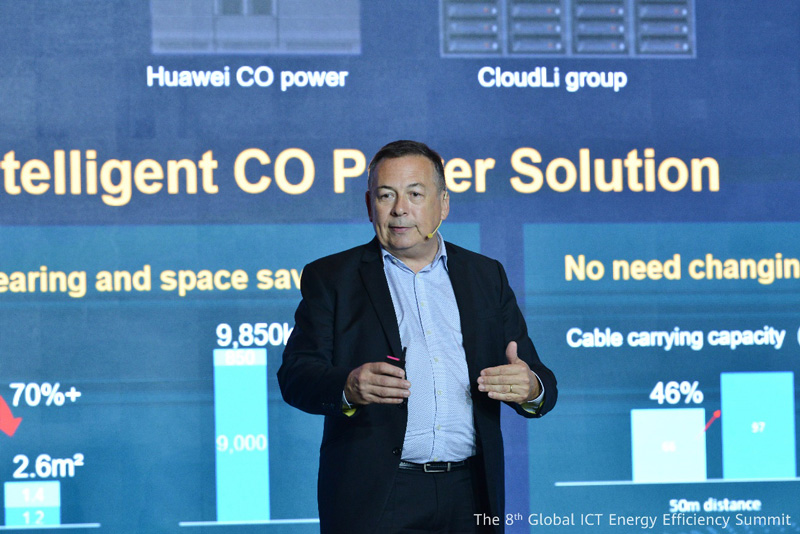 Michel FRAISSE, Vice President and CTO of Huawei West European
Digital Power
Michel FRAISSE, Vice President and CTO of Huawei West European
Digital Power
Michel FRAISSE, Vice President and CTO
of Huawei West European Digital Power, stated that as energy consumers, operators need to
reconstruct energy facilities using efficient power consumption solutions. Therefore, Huawei
proposes the concept of "Site Power Target Network" to provide end-to-end solutions that feature
simplified site construction, green power supply, and low-carbon operation, helping operators
build green and low-carbon networks.
-
Simplified site construction: Promote the
simplified evolution of site structure from equipment rooms to cabinets and from
cabinets to poles. As a result, the site area reduces from 12 m2 to "0"
m2 (the blade power supply can be installed on a wall or pole), and the site
energy efficiency (SEE) improves from 60% to 97%.
-
Green power supply: PV systems can be
flexibly deployed at sites to cut the use of grid and gensets. Clean and green
electricity emerges as the main energy source for operators' networks.
-
Low-carbon operation: All-round application
of lithium batteries is recommended to transform site energy storage from power backup
only to intelligent energy storage, which unleashes the value of energy storage assets
by minimizing energy storage investment and energy consumption. Digital technologies are
used to build a next-generation energy management system to efficiently manage energy of
an entire network through visualized, manageable, and optimizable energy efficiency and
carbon emissions.
Huawei Launching the All-Scenario Smart Telecom Power
Solutions
The power system is an important
component in the telecom site energy solutions and the core hub for power flow at sites. It
directly impacts the SEE. At this summit, Site Power Facility Domain of Huawei Digital Power
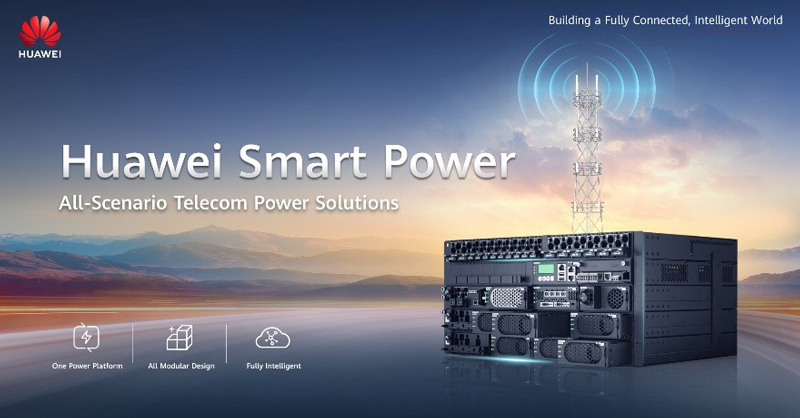
launched the All-Scenario Smart Telecom Power Solutions, aiming to build excellent power systems
that meet operators' needs for "one-time deployment, ten-year evolution."
-
Simplified: To expand the capacity of
traditional power systems, multiple sets of devices need to be added. Huawei Smart Power
adopts the modular design, and supports on-demand configuration and elastic capacity
expansion, achieving capacity expansion with only one set. It features a high density
with a volume of only 50% that of a tradition power system, facilitating deployment. It
supports multi-energy inputs and multiple outputs, and features strong compatibility and
applicability. By deploying the Huawei Smart Power, operators then have an ICT converged
power supply at sites to develop diversified services.
-
Intelligent: Intelligent circuit breakers
are used. Users can define the circuit breaker capacity, label, usage, and group through
software. Functions such as power usage authorization, intelligent metering, backup
slicing, and remote battery test are supported. Compared with traditional power systems,
this solution meets customized requirements and greatly improves the flexibility,
accuracy, and efficiency of power management at sites.
-
Green: The rectifier efficiency is up to
98%. The solution supports grid-battery, genset-battery, and PV-battery hybrid power
usage, which helps save electricity or remove gensets, and improve the green power ratio
and reliability. It supports load-level carbon emission analysis and management,
accelerating low-carbon network construction.
Motivated by "Green Site, Building a Brighter Future", Huawei Site
Power Facility has been delving into green ICT energy technologies and solutions to help
operators build green and low-carbon networks and achieve energy transformation.