[January 19, 2024, Shenzhen, China]
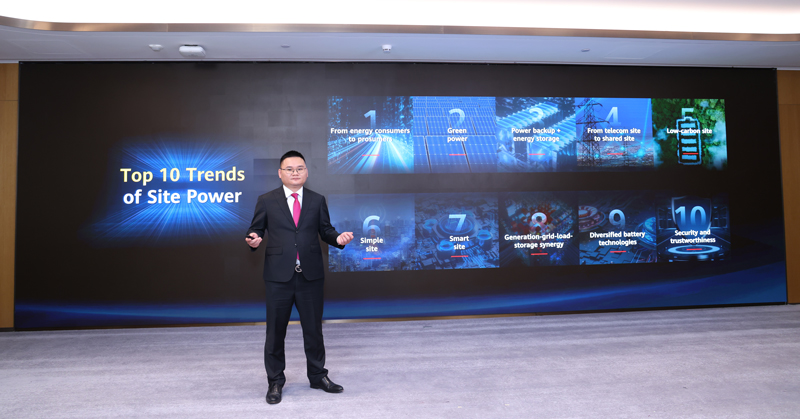
Huawei Digital Power released the White Paper on the Top 10 Trends of Site Power 2024. At the
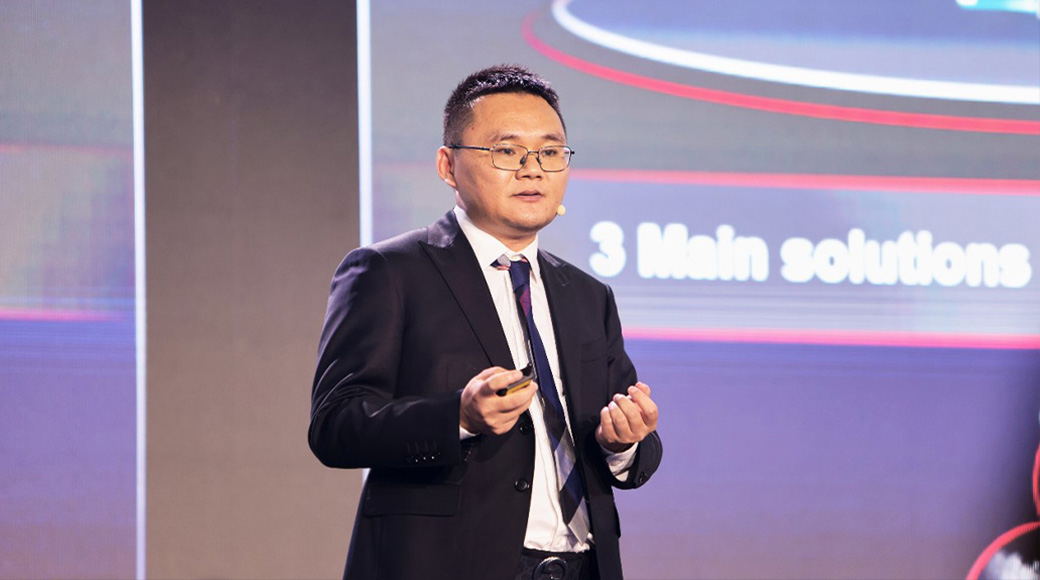
release, Li Shaolong, President of Huawei Site Power Facility Domain, gave a comprehensive
interpretation of the top 10 trends.
 Li Shaolong, President of Huawei Site Power
Facility Domain
Li Shaolong, President of Huawei Site Power
Facility Domain
Trend 1: From Energy Consumers to Prosumers
Driven by multiple factors, operators
and towercos will not only be energy consumers but also energy producers, and will actively
participate in revolutionizing global energy mix and constructing a low-carbon society.
-
As
energy consumers: Build green and low-carbon networks to enable network
evolution without adding energy operational expenditure (OPEX).
-
As
energy producers: Engage in green power production and scheduling (electric
power auxiliary services or residential power supply) to reap energy revenues by
deploying new energy facilities such as the PV system and energy storage system
(ESS).
Trend 2: Green Power
For the telecom energy sector, a
standardized green power system will be built from three dimensions: energy self-sufficiency,
reasonable benefits, and safety and stability, therefore making the construction and use of
green sites a new normal.
-
Energy self-sufficiency: In the context of
the reduced cost of green energy (such as solar energy), rising energy expenditure and
unstable energy supply due to the energy crisis, and carbon-neutral networks, the
construction of green sites helps operators and towercos achieve energy
self-sufficiency.
-
Reasonable benefits: The PV system
architecture of sites shifts from low-voltage parallel connection to high-voltage serial
connection, greatly reducing CAPEX. And by deploying smart optimizers, each PV module is
optimized independently, which improves the overall green energy yield, thus generating
more financial returns.
-
Safety and reliability: With the
introduction of intelligent active safety technologies (such as DC arc detector and
arc-fault circuit interrupter) and formulation of relevant standards, the system will be
better safeguarded.
Trend 3: Power Backup + Energy Storage
From only power backup to power backup
+ energy storage. There will be more cyclical applications, such as the peak staggering and the
virtual power plant (VPP) services. The telecom VPP energy storage system (referred to as the
"VPP system") features simplicity, intelligence, and multi-service convergence.
-
Simplicity: The VPP system adopts a simple
self-networking architecture that is decoupled from the existing power supply, enabling
operators and towercos to add VPP services smoothly.
-
Intelligence: Equipped with the intelligent
collaborative capability featuring extensive, fast, and precise adjustments, the VPP
system allows users to engage in electric power auxiliary services.
-
Multi-service convergence: One VPP system
integrates multiple services, such as staggering power consumption, demand-side
response, and frequency response, facilitating its long-term evolution.
Trend 4: From Telecom Site to Shared Site
In addition to supplying power for
communication services, telecom sites can develop diversified services such as "communication +
edge computing" or "communication + residential power supply" according to local needs,
expanding the service scope of sites. Telecom sites support the eMIMO mode and intelligent
collaboration to provide more advanced services.
-
Multi-mode power supply: The power supply
transforms from simple AC/DC conversion to multi-mode architecture. One power supply
supports multiple energy source inputs and multi-mode outputs.
-
Intelligent collaboration: The power supply
should support intelligent collaboration to ensure stable services even in complex
scenarios with multiple power inputs and various downstream devices, while continuously
optimizing the system for cost-effectiveness and profitability.
Trend 5: Low-Carbon Site
Against the backdrop of the continuous
growth in network power consumption, energy crisis, and the emission reduction demand raised by
carbon neutrality, global operators and towercos will continue to build low-carbon sites. A
refined mode characterized by multiple standards, multiple solutions, and intelligent management
is adopted to accelerate the development of low-carbon sites.
-
Multiple standards: Multi-dimensional
scientific standards, such as the site energy efficiency (SEE) and network carbon
intensity energy (NCle) indicators, are used as the evaluation basis to guide the
top-level design of low-carbon networks.
-
Multiple solutions: In addition to
approaches like "changing rooms to cabinets and cabinets to poles" to achieve "air
conditioner removal and energy efficiency improvement", PV deployment and genset-free
hybrid power supply can also help reduce network carbon emissions.
-
Intelligent management: Intelligent site
management enables the visualization of energy efficiency and carbon emissions,
providing a systematic and targeted approach to energy saving and emission
reduction.
Trend 6: Simple Site
Operators continue to build energy
networks featuring simple architecture, premium quality, cost-efficiency, and optimal
experience, constructing simple sites across multiple dimensions.
-
Simple architecture: Sites are greatly
simplified from equipment rooms to cabinets and from cabinets to poles. With the
advancing of outdoor blade power supply and blade battery technologies, cabinets at
sites are replaced with poles.
-
Premium quality: Blade power supplies and
blade batteries are maintenance-free throughout their lifecycles, coupled with the
intelligent remote O&M, which helps relieve burdens of maintenance on site power
facilities to a great extent.
-
Cost-efficiency: While with low costs of
individual components, traditional sites feature high hidden costs, whereas costs in
simple sites are reduced from construction to maintenance in an end-to-end
manner.
-
Optimal experience: Energy efficiency and
carbon emissions are remotely monitored, managed, and optimized. Intelligence delivers
efficient management, and efficient management leads to excellent experience.
Trend 7: Smart Site
With the aid of power electronics and
digital technologies, the full link of sites from power generation, conversion, storage,
distribution, consumption, to management operates on an intelligent basis. By "managing watt
with bit", the power supply system enters a smart era.
-
Intelligent generation: Smart optimizers
enable intelligent PV power generation at sites. Shading losses are reduced,
facilitating power generation; the system is automatically shut down in the case of PV
string faults, ensuring safe operations; remote O&M helps relieve burdens of
maintenance.
-
Intelligent conversion: The traditional
power supply is upgraded to a smart power supply, improving power conversion
efficiency.
-
Intelligent storage: Lead-acid batteries
and common lithium batteries are upgraded to intelligent lithium batteries, transforming
simple power backup into integrated backup + energy storage.
-
Intelligent distribution: Traditional
circuit breakers are upgraded to intelligent circuit breakers for more precise power
distribution.
-
Intelligent consumption: The power supply
is flexibly adjusted based on services of main network devices to achieve refined power
consumption.
-
Intelligent management: The intelligent
network management system enables the remote monitoring, management, and optimization of
energy efficiency and carbon emissions at sites.
Trend 8: Generation-Grid-Load-Storage Synergy
The power supply system, power grid,
and load devices of a site are no longer isolated from each other to achieve intelligent
generation-grid-load-storage synergy. For example, the intelligent peak shaving function of
batteries helps operators expand site capacity without reconstructing the mains, accelerating
site deployment; the collaboration of PV and battery technologies help store the surplus PV
power, achieving zero energy waste and greater benefits; by engaging in power services including
intelligent peak staggering and the VPP, sites can deliver extra energy benefits; the power
supply is flexibly adjusted based on services of main network devices to achieve refined power
consumption.
Trend 9: Diversified Battery Technologies
Batteries at telecom sites is evolving
towards diversification in terms of materials, applications, and management technologies.
-
Materials: Sodium battery materials are
more accessible and cost-effective. From lead-acid batteries to lithium batteries and
then to sodium batteries, battery materials will be further diversified.
-
Applications: Lead-acid batteries and
lithium batteries, due to their material properties, cannot satisfy all application
needs of communications networks. With the diversification of battery materials, the
application scope of batteries will be further expanded. For example, sodium batteries
feature high stability, a wider operating temperature range, and high applicability in
low-temperature scenarios. In addition, sodium batteries have a faster charging rate to
support extensive cyclic applications in the energy storage system.
-
Management technologies: Energy storage
systems are moving from simple parameter management such as state of charge (SOC) and
state of health (SOH) towards intelligent management that supports intelligent hybrid
use, intelligent anti-theft, intelligent voltage boosting, and VPP access
functions.
Trend 10: Security and Trustworthiness
Operators will build secure and
trustworthy energy networks centering on device security, network security, security
authentication, and trustworthy process and result.
-
Device security: Component security, device
usage security, and maintenance safety are required at the device hardware level.
-
Network security: Energy networks must be
secured in terms of architecture, data, and defense against attacks.
-
Security authentication: Energy networks
must pass various security qualification certifications (such as EU's CE-RED) and comply
with security regulations and standards.
-
Trustworthy process and result: Energy
networks should incorporate the security and trustworthiness requirement into the
product development process, focus on vulnerability management and privacy protection,
and ensure that the process and result are secure and trustworthy.
By releasing the top 10 trends of site
power in 2024, Huawei Digital Power aims to deliver the benefits of technological innovation and
promote the development and prosperity of the industry, as parts of our contributions to the
sustainable development and business success of operators and towercos.
For more information, please click the
below link. White Paper on the Top 10 Trends of Site Power 2024: https://digitalpower.huawei.com/my/events/232