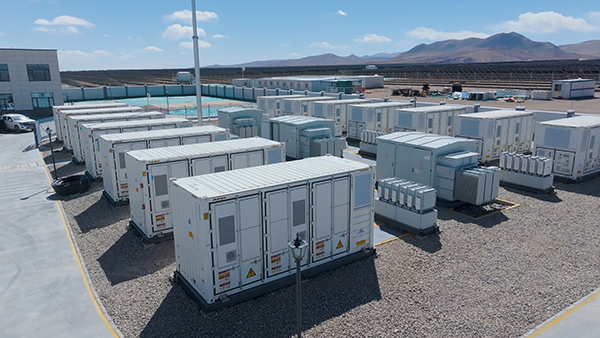
A grid-forming energy storage project was commissioned in an extreme environment characterized by thin air and freezing temperatures at an altitude of 4,600 meters in Gertse County, Xizang. This pioneering project has paved the way for the commercialization of grid-forming energy storage.
As the global energy transition accelerates, power systems are undergoing an unprecedented transformation. For more than a century, power grids have been designed around conventional energy sources. Now, as renewable energy sources such as solar and wind power become primary generation assets, grids must transform from passively adapting to actively managing power flow, becoming more complex and intelligent in the process.
In this context, grid-forming technology has emerged as a cornerstone of new power systems.
The 30 MW PV + 6 MW/24 MWh grid-forming energy storage project in Gertse County began operations in 2024. It stands as the world's first project of its kind in a high-altitude, extremely cold, and weakgrid environment. The success of the project marks the commercialization of grid-forming technology. It is not just a power plant, but a milestone of the energy revolution on the roof of the world.
Extreme Challenges on the Plateau
Gertse County is located at an altitude of 4,600 meters in the Ngari Prefecture of Xizang. Thin air and freezing cold make the area a lifeless zone. In winter, the temperature drops to –35°C or lower. Such an environment is extremely harsh for human survival, let alone the long-term stable operation of sophisticated renewable energy equipment.
A more significant challenge comes from the power grid itself. The grid in Gertse County is inherently weak and becomes increasingly vulnerable as the proportion of renewable energy and power electronic devices increases. Consequently, the 30 MW PV system's output was limited to 1.5 MW, resulting in more than 95% of green power being curtailed. This reduced the utilization of renewable energy, negatively impacting local power supply and economic development.
In traditional power systems, grid stability depends on the inertia and regulation capabilities of large synchronous generators. However, in extreme conditions, such as weak grids and high altitudes, traditional approaches often fail. These conditions make Gertse an ideal test field for grid-forming energy storage technology. If the technology succeeded there, it would be capable of handling the most complex scenarios worldwide.
To address these challenges, Huawei Digital Power proposed its high-quality Smart String Grid Forming Energy Storage System (ESS). Unlike traditional centralized energy storage architecture, a string design makes energy storage units more flexible and intelligent. They can operate in a distributed manner, like individual cells, while collaborating to deliver significant performance.
In the Gertse project, the grid-forming ESS not only functions as an energy regulator for batteries and inverters, but also works as a grid stabilizer:
∙ Proactive inertia provision: When the grid frequency changes sharply due to fluctuations in wind and solar power, the ESS discharges energy instantly to prevent grid instability, similar to a traditional thermal power unit.
∙ Voltage support and damping control: The ESS rapidly adjusts reactive power to stabilize grid voltage and prevent system oscillations.
∙ Wideband oscillation damping: In grids with a high density of power electronic devices, complex oscillations are readily generated. Huawei ESS effectively damps oscillations across low and high frequencies.
These capabilities enable the ESS to evolve from a gridfollowing to a grid-forming role in a new power system.
Reliability Verification Under Extreme Testing
Regardless of how flawless a theory may be, it must be validated through practical application. During project implementation, the Xizang Electric Power Research Institute of the State Grid Corporation of China (SGCC) conducted rigorous tests on the ESS, including a 35 kV short-circuit disturbance test, a power conversion system (PCS) connection test, and a transient inrush current test.
The test results show that Huawei ESS can supply three times the apparent current within 10 ms and remains connected to the grid even during large disturbances, demonstrating excellent resilience under extreme conditions. The Xizang Electric Power Dispatching and Control Center of SGCC certified that the upper limit of PV output increased from 1.5 MW to 12 MW after the ESS began operating in grid-forming mode, delivering exceptional performance. In other words, every 1 MWh of Huawei Grid Forming ESS enabled an additional 1.75 MW of PV output.
According to Yang Mingsheng, General Manager of the Gertse PV+ESS project, "During a 10-day obtain period, there were more than 30 major disturbances on the power grid. The Huawei Grid Forming ESS reliably supported the grid voltage and frequency every time." The data is more convincing than any appreciation.
The Gertse project does more than solve power supply challenges in a single region. It represents a replicable technical pathway: In weak grids with a high proportion of renewable energy, grid-forming ESSs can effectively enhance grid integration and resilience. This is especially valuable for regions rich in clean energy resources but with weak grids, such as western China, Africa, and Latin America.
If traditional ESSs are supportive tools for renewable energy development, then grid-forming ESSs are new engines for energy system transformation. They transform grids from passive bearers to active organizers capable of integrating a much larger share of renewable energy.
Commercial Breakthrough and Global Significance
The success of the Gertse project signifies that gridforming technology is bridging the gap between research and commercialization. Previously, most ESSs were deployed in demonstration or policy-driven projects. Now, grid-forming ESSs are delivering distinct commercial value, generating benefits such as doubled PV output capacity and enhanced grid stability.
This concerns not only the profitability of a power plant, but also the advancement of the global energy transition. According to the International Energy Agency (IEA), more than 1.5 TW of wind and solar PV installations are expected to be added by 2030. Without ESSs and grid-forming capabilities, it would be impossible to integrate large amounts of renewable energy into power grids. The success of the Gertse project sets a feasible pathway for the large-scale integration of renewable energy globally.
It is noteworthy that a Chinese company achieved this technical breakthrough. It showcases Huawei's profound expertise in cross-disciplinary fields such as power electronics, digital control, and intelligent algorithms. More importantly, it establishes China's competitive edge in developing next-generation power systems.
From the Plateau to the World
When renewable energy illuminates the roof of the world, it reveals the power of technology, perseverance, and foresight. The Gertse grid-forming energy storage project is more than a power plant in West China; it is a beacon on the energy landscape of the future. It demonstrates our ability to harness green energy in extreme environments to advance social progress.
As an ancient Chinese teaching goes, all good principles should adapt to changing times to remain relevant. The grid-forming journey from Gertse is leading to a broader horizon for global energy transition. As the successful experience is replicated in more regions, grid-forming ESSs will not just be a miracle on the roof of the world, but a shared foundation for global new power systems.
In the coming chapters of energy history, there will be this record: On the snowy plateau at an altitude of 4,600 meters, a new era of green power was inaugurated by a group of determined and insightful engineers.
Disclaimer: The views and opinions expressed in this article are those of the author and do not necessarily reflect the official policy, position, products, and technologies of Huawei Digital Power. If you need to learn more about the products and technologies of Huawei Digital Power, please visit our website at digitalpower.huawei.com or contact us.