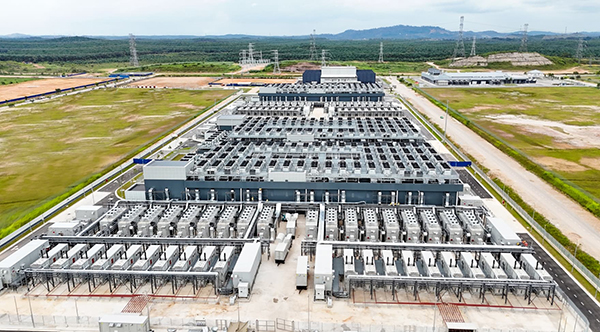
A benchmark AI data center project in Johor, Malaysia, has achieved what many thought was impossible: completing a 60 MW high-density data center in just 11 months. This sets a new benchmark for AI data center construction in the Asia-pacific region. The question is, how was all this achieved?
The answer lies in the philosophy that guides the project: time is the ultimate test, and innovation is the only possible response. Amidst the tropical sea winds of Johor, Malaysia, a new AI data center campus was built. The first phase of the project, with a total capacity of 60 MW, achieved service rollout within 11 months of construction.
This project was completed at a pace deemed nearly impossible in the data center field, setting a record for construction timeline and a new benchmark for AI data centers. This achievement was made possible by Huawei's data center facility solutions, which deliver reliability, agility, and sustainability, enabling customers to achieve a leap in benefits previously deemed unattainable.
Challenges
With the AI boom, computing giants and colocation operators are pouring into Johor, Malaysia, transforming it into a hotspot for data center investment. In the AI computing era, speed is critical, and time is money. The ability to rapidly deploy AI services and computing resources equates to tens to hundreds of millions of dollars in commercial returns. To gain a competitive advantage, the data center customers presented what seemed an impossible demand: deliver a 60 MW data center within 12 months, with power density exceeding 20 kW/rack and a power usage effectiveness (PUE) no higher than 1.4.
Conventionally, it was believed that deploying a data center of comparable scale would take at least 24 months. Making matters worse, located at the southern tip of the Malay Peninsula and close to the equator, Johor is known for its yearround high temperature and humidity. And due to the impact of municipal infrastructure, water resources are limited.
At the same time, the high power density of AI computing presents unprecedented challenges to system reliability, space layout, and cooling methods. The project had to be fast, stable, high-density, green, and low-carbon.
This was, without exaggeration, a high-stakes engineering game testing the limits of innovation.
Solution
∙ Modular Architecture and Prefabricated Delivery
Faced with the 12-month rollout timeframe, in response to this seemingly impossible mission, Huawei Digital Power worked with ecosystem partners to adopt an innovative solution─prefabricated modular construction. The data center's IT data halls and electromechanical facilities adopted a fully modular architecture, with the IT data halls decoupled from the power supply modules. The three buildings bearing 60 MW IT load were constructed using nearly 1,000 "Lego-like" prefabricated modules. The prefabrication of these modules proceeded in parallel with onsite civil construction. These modules were then quickly assembled upon delivery. By leveraging modularity for agility and decoupling for flexibility, the project reduced the traditional 24-month project duration to 12 months, shortening the rollout time by 50%.
This "building-block" data center construction mode not only significantly enhanced construction and delivery efficiency, but also ensured high quality through the indepth integration of standardized design and industrialized production. Engineering productization means pursuing excellence and elegance in every detail. Each cable and bolt was optimally configured during prefabrication, reducing uncertainties during on-site construction and ensuring efficient delivery and excellent quality.
∙ Distributed Architecture, One Power System Per Container
Surging compute demands in the AI era introduce significant uncertainty: fast service changes, large load fluctuations, and enlarged failure domains. Ensuring security and reliability becomes essential. As the "heart" of the data center, the project's core power supply system adopted a distributed architecture and Huawei's FusionPower9000 outdoor PowerPOD. One power system was deployed per container, and the modules were decoupled. If any module failed, other modules could continue to operate independently. The solution prevented fault propagation, minimized the failure domain, and guaranteed uninterrupted business operations. This meant the "heart" of the data center would not fail due to local faults. To a certain extent, the data center is selfhealing and provides dynamic resilience.
In addition, the outdoor PowerPOD incorporates a lithium battery backup system that was decoupled from the main buildings and deployed separately from the IT data halls. This design isolates potential failure domains outdoors, thereby minimizing service impact and enhancing the AI data center's resilience.
∙ High Density and Efficiency, Green and Low-Carbon Development
To address heightened energy concerns and accelerate carbon-neutrality goals, the customer, as a leading colocation provider, had to build a high-performance data center and champion green principles, positioning itself as a pioneer in low-carbon, sustainable development.
The project incorporated Huawei's FusionPower9000 outdoor PowerPOD to build a high-density, integrated power supply solution. The UPS, lithium battery system, and low-voltage power distribution system were integrated into a single POD. With a capacity reaching 2.7 MW, a single module occupied less than 50 square meters. This design saved about 40% of the power room area while also improving the power supply efficiency across the entire link, achieving "more with less."
Additionally, an innovative air-cooled fan wall solution was used for data center cooling. This solution requires no water consumption while providing highly efficient heat dissipation, achieving an excellent PUE of approximately 1.4 in Malaysia's hot, humid tropical climate.
Achievements
At the end of July 2024, three data center buildings with a total IT capacity of 60 MW were fully commissioned and operational. The project became one of the largest colocation data centers in Malaysia and a crucial highdensity AI computing hub in the local region.
The success of the project not only enabled the customer to seize the opportunities in the booming AI data center market but also provided strong support for its subsequent business development. More importantly, the project set a new industry benchmark for the entire Asia-pacific region. Reliability, agility, and sustainability have become the new standards for regional data center construction.
The project has become a benchmark for AI data center construction in Johor. Following this success, an increasing number of data center builders have adopted its approaches: modular design, distributed architecture, outdoor PowerPOD, functional area decoupling, and remote backup power deployment. This has rapidly emerged as a mainstream model in the Asia-pacific region.
Benefits
This 11-month feat represents more than a technical triumph; it's also a breakthrough in our fundamental understanding of data center construction. From its architecture down to its physical implementation, the project demonstrated a new understanding of AI computing through technology: speed is not a compromise on performance, but rather a new dimension of efficiency; integration is not merely about reduction, but a deep synergy of efficiency and reliability; sustainability is not a slogan, but the essence of computing.
As a famous saying goes, "The only reason for time is so that everything doesn't happen at once." The story of this 60 MW AI data center demonstrates that when innovation is sufficiently profound, the very order of time can be redefined. Its success has led to a redefined understanding of "speed"—not merely compressing schedules, but achieving a harmony of speed and sustainability, and ensuring reliability through innovation.
In the midst of the surging AI wave, this landmark project stands as a beacon, illuminating the path toward a future of smart energy and green computing. It demonstrates to the world that when technology merges with energy, and when intelligence moves in harmony with speed, even the socalled "impossible" chasm can be bridged.