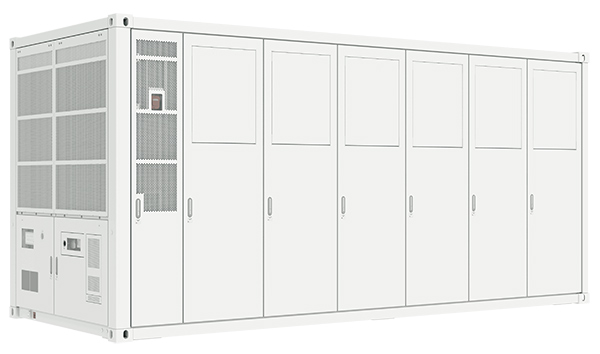
The growing proportion of renewable energy and power electronic devices is introducing unprecedented stability challenges to power grids. Huawei's Smart String Grid-Forming Energy Storage System (ESS) addresses these challenges by integrating six core capabilities with an end-to-end quality management system, facilitating high-quality development of new power systems and leading the energy storage industry into a new grid-forming era.
While the accelerating global energy transition is driving the adoption of renewable energy generation, it is also introducing unprecedented challenges to power systems. The increasing penetration of renewable energy and power electronic devices significantly compromises grid stability.
Grid-forming ESSs can proactively support grid voltage and frequency, making them a cornerstone of new power systems.
Huawei's Smart String Grid-Forming ESS delivers true grid forming while ensuring high standards of quality and safety. It addresses four major technical challenges facing the industry and opens up a new era of all-scenario grid forming.
Power Grid Dilemma: Stability Crisis Amid the Renewable Energy Transition
As renewable energy becomes more prevalent, power systems are facing growing risks in terms of random power fluctuations, inadequate frequency and voltage regulation, and oscillations. This has given rise to the emergence of grid-forming energy storage as a foundational technology for new power systems.
However, four major technical challenges hinder the large-scale application of this technology worldwide:
First, parallel operation stability is a primary challenge. Circulating current among multiple parallel-connected voltage sources reduces system stability.
Second, high-power, high-rate operation can induce wideband oscillations, which are difficult to suppress.
Third, overload current leads to significant power device losses, resulting in overheating, failure, and equipment damage.
Fourth, the current backfeed that occurs due to transient overvoltage from the power grid compromises ESS safety and reliability.
Six Core Capabilities: Driving the Advancement of Grid-Forming Energy Storage Technology
A grid-forming ESS simulates the operating characteristics of synchronous generators and proactively supports grid voltage and frequency. This is achieved by transforming a traditional ESS from a grid-following to a grid-forming role.
Huawei Digital Power spent over a decade advancing research in grid-forming technologies. By integrating strengths in hardware, architecture, and algorithms, it has established six core capabilities for utility-scale grid-forming ESSs.
Capability 1: Inertia response
Huawei's grid-forming ESS provides virtual inertia support within 5 ms. The inertia time constant can be adjusted from 0 to 20 seconds, enabling frequency control in diverse scenarios.
Capability 2: Primary frequency regulation
A quick power response is key to handling sudden changes in grid frequency. Huawei's grid-forming ESS excels in primary frequency regulation. It supports Smart Power Plant Controller (SPPC)+Power Conversion System (PCS) interaction and collaboration, and enables 200 ms plant-level rapid response and constant power output in the range of 0-100% state of charge (SOC). This ensures both stable frequency and higher plant revenue.
Capability 3: Short circuit capacity
A robust short circuit capacity is key to maintaining grid stability. During low voltage ride-through, 3x reactive current can be released for 10s, providing powerful support. During high voltage ride-through, the two-stage architecture prevents backfeed and ensures stable control with active power deviation below 10%.
Capability 4: Power oscillation damping
Power electronic devices cause oscillations across a wider frequency range—an issue that involves more extensive and complex control loops. Huawei's grid-forming ESS ensures reliable grid connection across the full short-circuit ratio (SCR) range and provides 0.1-100 Hz wideband oscillation damping throughout the ESS lifecycle.
Capability 5: Black start
Black start is a critical capability for maintaining power system reliability during a power grid outage. The voltage ramp-up from zero of the entire plant is achieved within seconds for black start, and a capacity ratio of 1:1.5 prevents system collapse during transformer energization without load. The capability of GWh-level black start restores power for the entire plant within minutes, rapidly bringing the power system back online and minimizing outage-related issues and societal impact.
Capability 6: On/off-grid switching
Huawei's grid-forming ESS can seamlessly switch between on-grid and off-grid modes, prevents power interruption for users. In off-grid mode, the ESS independently establishes voltage and serves as a temporary supply for critical loads.
End-to-End Quality Management: Setting a Benchmark in the Energy Storage Industry
Huawei Digital Power prioritizes both high quality and safety and has established an end-to-end quality management system covering business planning, design, development, manufacturing, procurement, marketing, sales, delivery, and operations and maintenance (O&M).
During the simulation phase, Huawei uses a digital twin platform to simulate and verify systems, proactively identifying and resolving serious safety and operational risks to ensure product and solution reliability. For example, in the 100% renewable microgrid project for The Red Sea destination in Saudi Arabia, Huawei developed ultra-high-precision digital twin models for PV and ESS devices, with simulation errors controlled to within 2%— significantly better than the industry average of 10%. Huawei FusionSolar's modeling and simulation platform has delivered over 1,000 models for more than 60 countries and regions.
During the testing phase, Huawei conducts long-term testing of each new-generation product in labs and at five outdoor test bases designed to simulate extreme environments such as high humidity and salinity, high temperature and sandstorms, high altitude and strong radiation, and extreme cold. These rigorous tests ensure product quality and stability. To test the performance of ESSs in extremely cold environments, Huawei built a lab capable of simulating –50°C temperatures—here, products undergo continuous operation for thousands of hours to verify stability. In February 2025, Huawei collaborated with DNV, an internationally recognized testing organization, to conduct extreme ignition tests on its Smart String Grid-Forming ESS. During the testing, thermal runway was manually triggered and multiple cells burned for hours. Despite this, the ESS successfully achieved the goal of "no fire, no explosion, no fault propagation, and no injury." Temperatures of adjacent battery packs were controlled throughout the process, demonstrating the industry-leading safety of Huawei's ESS safety design.
During the O&M phase, Huawei implements pack-level thermal runaway control and end-to-end, multi-dimensional intelligent diagnostics through the battery management system (BMS) to ensure active safety via both software and hardware. An AI algorithm accurately predicts more than 10 types of cell and pack risks one to seven days in advance, preventing potential hazards such as battery abuse and internal or external short circuits. This approach enables a fundamental shift from passive response to proactive prevention.
Safety Foundation: Five Layers of Defense Throughout the Lifecycle
ESSs are critical components of new power systems. Because any safety incident or fault has the potential to compromise the stability of the entire system, safety and reliability must be the top priority of the energy storage industry.
Huawei's grid-forming ESS features a five-in-one safety protection system that covers cells, packs, racks, containers, and the grid, implementing the following defense methods:
· Source control: Huawei enforces stringent control at the source, applying the world's strictest qualification standards and full-lifecycle quality management to cell suppliers. Comprehensive risk prevention establishes a solid safety foundation.
· Mechanical safety and directional pressure venting: At the pack and rack levels, Huawei uses reinforced structures, positive-pressure oxygen barriers, and directional explosion venting designs to maximize safety. These designs physically isolate risks, making them controllable and manageable. In the event of cell thermal runaway, the system vents pressure in a controlled manner to effectively suppresses thermal and fire propagation. This ensures personnel safety, protects surrounding equipment safety, and minimizes the impact of faults.
· Refined management and intelligent warning: Huawei uses an advanced string architecture to independently manage and precisely control each energy unit, ensuring efficient and healthy system operation. Additionally, Huawei leverages cloud-based big data and AI diagnostics to build an intelligent safety protection mechanism that transforms O&M from passive protection to proactive warning. This mechanism enables early detection of potential risks and prompt intervention, improving system predictability and operational safety.
Huawei Digital Power has established "no fire, no explosion, no fault propagation, and no injury" as its foundational safety principles, extending safety management from the initial design phase throughout the entire product lifecycle. Building on this foundation, Huawei Digital Power introduced a safety risk matrix and collaborated with customers and industry organizations to develop a full-lifecycle, quantitative safety assessment system for electrochemical ESSs. This system successfully passed an authoritative technical appraisal organized by the China Electricity Council on November 18, 2025.
The appraisal committee unanimously concluded that the system sets a new global benchmark, closing critical technical gaps in ESS safety both within China and globally.
Summary
Grid-forming energy storage is not only a technological innovation but also a cornerstone for new power systems. Huawei's grid-forming ESS overcomes industry technical barriers through its six core capabilities, while integrating five layers of safety protection and end-to-end quality management to establish a safety benchmark for the industry. Looking ahead, Huawei will continue to collaborate with more customers and partners to lead the energy storage industry into the grid-forming era.
Disclaimer: The views and opinions expressed in this article are those of the author and do not necessarily reflect the official policy, position, products, and technologies of Huawei Digital Power. If you need to learn more about the products and technologies of Huawei Digital Power, please visit our website at digitalpower.huawei.com or contact us.