[Johannesburg, South Africa, 18 March
2024] At the Solar & Storage Live 2024, Africa's largest renewable energy exhibition that
celebrates the technologies at the forefront of the transition to a greener, smarter, more
decentralized energy system, aims to accelerate Africa’s sustainable energy future. At the
event, David Bian, Director of Huawei Digital Power Sub-Saharan Africa, Smart PV Development
Department, delivered a keynote speech entitled " Building a New Power System for a Better,
Greener Future in Africa "
David said, we are now living in the
era of carbon neutrality. Energy is the foundation for the development of our civilization. An
energy transition is vital to our advancement efforts. Decarbonization, electrification,
digitalization, and intelligence are four key pathways for the energy transition.
To address the challenges implicated
by carbon neutrality, the energy mix is rapidly evolving, calling for reducing carbon emissions
in power generation. Clean energy will replace conventional energy, and renewables will dominate
the future as their share in power generation will increase from 25% today to 91% by 2050. PV
will develop as a main energy source with considerable annual growth in installed capacity.
Energy storage will also play an irreplaceable role.
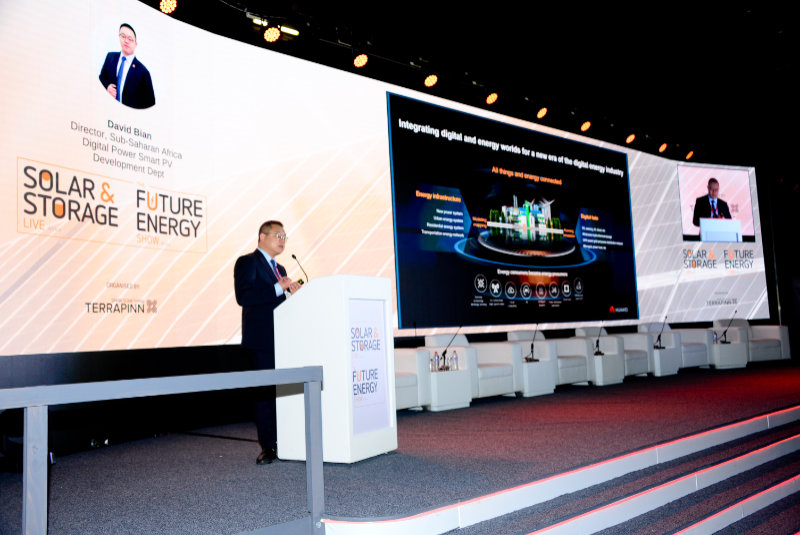
Mr. David Bian, Director of
Huawei Digital Power Sub-Saharan Africa, Smart PV Development Department
Electricity will become the main
energy source that will be consumed in the future. The share of electricity in energy
consumption will increase from 21% to 51% by 2050. Mobility electrification will play a pivotal
role in the process. The International Renewable Energy Agency (IRENA) estimates that the number
of electric vehicles will grow from 30 million at the end of last year to 2.18 billion.
Technologies such as 5G, AI, cloud,
and blockchain keep evolving and are penetrating every part of our economy and civilization.
Digital technologies will not only help improve efficiency but also build a foundation and
platform for innovation, fueling a variety of industries.
Intelligent applications, such as AIGC
models represented by ChatGPT, have triggered an explosion in intelligent computing power, which
will continue to increase exponentially in the future. AI will be deeply integrated into the
real economy. And it will change the way we work and drive a new round of technological and
industrial advances. Propelled by digitalization and intelligence, new energy systems will
emerge and evolve with closed-loop business models.
Following the trends of
decarbonization, electrification, digitalization, and intelligence, the digital and energy
worlds will be deeply integrated. It is fair to say that the energy industry has ushered in a
new era of digital energy. Great changes will take place in energy infrastructure development.
Digital, AI, and power electronics technologies will be further integrated. Power generation,
grids, loads, and energy storage will collaborate in a profound way. Consequently, energy will
be more efficiently utilized and resources will be better allocated.
Energy infrastructure for new power
systems, urban energy systems, and residential energy systems, is undergoing accelerated
transformation. Independent energy production or consumption are now integrated to achieve
optimal resource allocation and use efficiency. Huawei Digital Power converges bit, watt, heat,
and battery technologies and is committed to building new power system energy infrastructure in
the following three aspects:
In clean energy base scenarios, high
proportions of renewable energy and power electronics applications, large base footprints, and
remote locations pose challenges to grid connection and O&M. To overcome these challenges,
Huawei Digital Power leverages the grid forming technology, which is applied to PV and energy
storage systems (ESSs). By integrating digital and power electronics technologies, together with
advanced grid connection technologies, the PV+ESS solution can proactively enhance the power
grid and provide the functions of traditional synchronous generators, achieving the
transformation from grid following to grid forming and making PV energy the mainstream energy
source. In terms of O&M, Huawei Digital Power leverages IoT, big data, AI, and other ICTs to
implement the smart diagnosis of plant faults, achieving intelligent and unattended PV
plants.
In urban scenarios, it is a common
call to build green, low-carbon energy intelligent twins and integrate generation, grid, load,
storage, and consumption by integrating innovative products and solutions of distributed energy,
virtual power plants (VPPs), smart charging networks, V2X, integrated smart energy, and smart
microgrids. With joint efforts, a citywide energy Internet based on smart grids and smart
microgrids for a safe, resilient, efficient, low-carbon, and intelligent city can be realized
soon.
For home energy consumption, building a green, low-carbon, intelligent home energy
management system with the optimizer+PV+ESS+charger+load+cloud one-stop solution will transform
homes from energy consumers to prosumers in new power systems.

Mr. David Bian, Director of
Huawei Digital Power Sub-Saharan Africa, Smart PV Development Department
David also shared the best practices
to see how the four technologies promote renewable energy development:
Grid-forming ESS, Building the World's 1st 100%
Renewables-Powered City
Huawei blends smart string controllers
and smart string energy storage systems (ESSs) into its FusionSolar Grid-Forming Solution to
facilitate a stable power grid connection with a high penetration of renewables. The solution
has been applied in the 1.3 GWh microgrid for the Red Sea project in Saudi Arabia. Through the
world's first GWh-level PV+ESS grid forming system, Huawei contributes to the first city that is
fully powered by solar energy.
Intelligent O&M with AI, Ensuring High Quality and
Availability
In Gonghe County of Qinghai province,
China, Huawei helped the State Power Investment Corporation build the world's largest PV power
plant with a capacity of 2.2 GW, which generates more than 4 billion kWh of green electricity
every year. The Smart I-V Curve Diagnosis technology shortens the inspection time from 5 months
to 15 minutes, with the precision rate, recall rate, and reproduction rate exceeding 90%. The
technology reduces O&M costs and ensures efficient operation of the power plant.
Significantly advanced green energy, Lighting up Africa
with green energy
Huawei constructed Africa’s biggest
solar facility in South Africa with an impressive output of 540 MW, using over 2000
high-efficiency inverters. Remarkably, the plant stabilized within three months. In Ghana,
Huawei’s solar-hydro hybrid ESS project is slashing greenhouse emissions by 47,000 tons every
year. Furthermore, a Cape Town market now enjoys uninterrupted power thanks to a Huawei
microgrid, saving $81,000 annually on fuel. This investment pays for itself in under four
years.
Over all,Huawei’s solutions have generated 997 billion kilowatts of green power, saved
46 billion kilowatts of energy, and reduced emissions by 495 million tons, equivalent to
planting 680 million trees globally.