As of now, over 140 countries and regions worldwide have joined the carbon neutrality movement. These include large economies such as China, Brazil, Germany, and the UK, as well as many smaller countries with relatively scarce natural resources.
Singapore is one of these countries. Due to the reasons mentioned above, along with the government's forward-thinking policies, Singapore places greater emphasis on resource recycling compared to most countries, positioning itself as a leader in the green energy transition. Singapore not only leads by example but also employs effective measures such as legislation and strategic plans to regularly assess energy consumption facilities. In addition, the country encourages businesses and households to adopt more efficient energy devices and technologies.
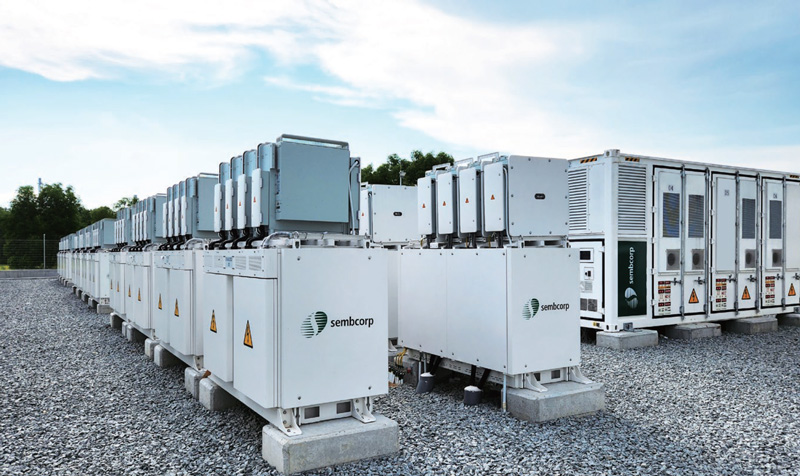
In December 2022, the 200 MW/285 MWh energy storage system (ESS) project on Jurong Island, constructed by Singapore's Sembcorp Industries, was officially launched. The project features a 115 MW/146 MWh Smart String ESS and technical support from Huawei Digital Power. Commissioned in six months, it is Southeast Asia’s the largest ESS at the point of completion and is the fastest in the world of its size to be deployed.*
A Construction Miracle in Six Months
Sembcorp Industries (Sembcorp), a leading renewable energy company and a renowned provider of industrial and urban solutions, is committed to driving the energy transition and sustainable development.
The company is on track to achieve its target of 10 GW of gross installed renewables capacity by 2025 and aims to grow its installed renewables capacity to 25 GW by 2028.
The Sembcorp ESS project on Jurong Island is a key part of this initiative.
In May 2022, the Energy Market Authority (EMA) of Singapore issued an expression of interest to build, own and operate an ESS in Singapore and subsequently appointed Sembcorp as the ESS developer and operator. The primary function of the Sembcorp ESS is to enhance power grid stability and resiliency. With a maximum storage capacity of 285 MWh, the ESS can meet the electricity needs of around 24,000 average four-room HDB households for one day, in a single discharge.
Its short response time to store and supply power in milliseconds is essential in mitigating solar intermittency caused by changing weather conditions in Singapore's tropical climate. Additionally, the Sembcorp ESS provides backup power to the grid. What is particularly remarkable is that, through close collaboration with partners such as Huawei Digital Power, the ESS achieved a construction-to-activation miracle, with the entire process completed in just six months. Throughout the planning, construction, and activation stages, the project attracted wide attention inside and outside the industry, with active involvement from various government agencies of Singapore.
The construction process of the ESS was not without challenges and setbacks. For example, the impact of Typhoon Muifa affected the delivery of project materials and logistics, and record-breaking rainfall in Singapore, the highest in 40 years, disrupted the onsite construction pace. However, through the joint efforts of Sembcorp and its global partners, including Huawei, these issues were resolved, and Singapore's first large-scale utility-scale ESS was successfully completed on time.
Leading Green Development Through Exemplary Practices
At the Banyan site of the project, Sembcorp fully adopted Huawei's Smart String ESS platform. The platform's innovative distributed temperature control system maintains the temperature difference between batteries within a specific range to ensure optimal battery lifespan.
As a critical pillar of the energy transition, the energy storage sector has long faced challenges in areas such as safety, efficiency, lifespan, and O&M. Leveraging its strong expertise in PV, energy storage, and ICT technologies, Huawei Digital Power has integrated numerous key technologies to create the innovative Smart String ESS platform.
This platform features a fully modular system design: the battery system can isolate faulty battery packs independently without affecting the normal operations of other battery packs in the battery rack. The modular design not only offers high availability but also allows for flexible deployment and smooth capacity expansion, minimizing the impact of faults. It also includes automatic SOC calibration, eliminating the need for site visits, which significantly reduces O&M costs.
Specifically, each battery pack is equipped with an energy optimizer, each battery rack is managed by a controller, and distributed cooling is enhanced by intelligent technologies. With these features, Huawei Digital Power minimizes problems of series mismatch between battery packs, parallel mismatch between battery racks, and battery temperature rise difference. With features like pack-level optimization and rack-level management, the ESS can improve its available energy by over 15% throughout its lifespan. In terms of safety, Huawei's Smart String ESS has also earned the rigorous certificate of conformity (CoC) for fire suppression of Singapore.
Huawei Digital Power also integrated advanced ICT technologies such as AI and cloud battery management system (BMS) into the solution to provide warnings for potential short circuits, transitioning from passive safety to proactive safety. Additionally, AI technology uses prediction models to forecast battery state of health (SOH). It employs intelligent battery lifespan, behavior, and environmental prediction models in conjunction with a smart temperature control strategy, optimizing the balance between battery degradation and temperature control energy consumption to ensure the optimal levelized cost of storage (LCOS) in real-time.
As a modular and smart next-generation ESS, the Sembcorp ESS can be easily configured to meet different needs and adjusted to support both on-grid and off-grid systems. Such an advantage can minimize system downtime and shorten response time during the replacement of faulty batteries.
Over a year since the project was launched, the Sembcorp ESS at Banyan has met the required performance parameters for discharge capacity and round-trip efficiency, playing a significant role in supporting Singapore's transition to clean energy.
As a testament to the close collaboration between the two parties, in July 2023, Sembcorp and Huawei Digital Power signed a memorandum of understanding (MOU). The two companies will cooperate on innovation in PV and energy storage technologies, microgrids, and other applications, strengthening grid resilience and stability, while continuing to enhance practices such as integrated PV through grid-forming energy storage technologies.
Undoubtedly, the construction and operation of the Sembcorp ESS marks a landmark event in Singapore's green energy transition. Not only is it of great significance, but its value is also exceptional. As stated in the Singapore Green Plan 2030, the goal is "to create a green, liveable, and sustainable home for Singaporeans." The Sembcorp ESS serves as a model, setting an example for Singapore's energy transition and firmly leading the sustainable development of this beautiful garden city with the power of example.
*Based on independent assurance provider DNV’s global database of 4,210 ESS projects totalling 32 GWh and publicly available information as of January 5, 2023 for a comparable size utility-scale ESS (same or higher rating and same design)