From land-based adaptation to marine ventures, the renewable energy sector is expanding into new frontiers. The world's largest open-sea off shore PV project in Dongying, Shandong, represents a significant leap forward, unlocking substantial solar potential at sea.
"will ascend the mountain's crest. It dwarfs all peaks under my feet." Du Fu's poetic tribute to Mount Tai embodies a spirit of boundless ambition. A millennium later, along another stretch of Shandong's coastline, that same spirit finds new expression: Above the vast Yellow Sea, a pioneering energy installation harnesses solar power above the waves.
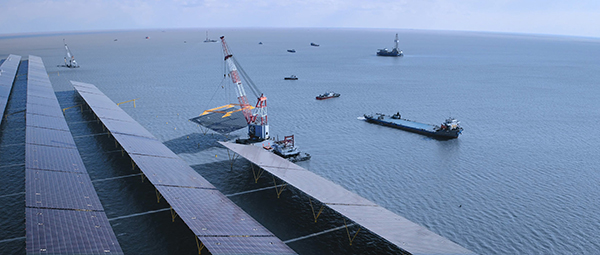
Located 8 kilometers off the eastern coast of Dongying, Shandong, extensive PV arrays shimmer with the promise of green energy. Here, the HG14 GW-level off shore PV project—developed by Guohua Investment Shandong Branch of CHN Energy—is steadily progressing.
A Bold Energy Venture Across Blue Waters
Covering approximately 1,223 hectares of marine area, the project has a total installed capacity of 1 GW, making it the world's largest open-sea off shore PV project. What was once confined to imagination—a GW-level off shore PV plant—has now become reality in Shandong's waters.
This project emerged from a broader strategic context. In recent years, Shandong Province has advanced its vision of becoming a "marine powerhouse in the new era" while actively advancing its green transition. As a leading stateowned enterprise, CHN Energy recognized off shore PV as a promising new frontier early on. The HG14 project is among the first pioneering projects to achieve grid connection. It marks not only a strategic breakthrough for the company but also a milestone for Shandong Province, the renewable energy sector, and China's ongoing energy transition.
Compared to land-based PV installations, off shore PV construction presents significantly greater challenges. Engineering teams must contend with high humidity, high salinity, strong waves, large tidal variations, and even the threat of drifting sea ice. Every little detail determines the safety and success of the entire project.
Off the coast of Kenli District in Shandong Province, 2,934 giant PV platforms extend in a linear formation. Each platform measures 60 meters long and 35 meters wide, equivalent to the area of five basketball courts. Standing atop them, one feels as though they are on a floating continent—an immense expanse of steel and PV panels shimmering across the waves.
These platforms are not assembled at sea. Instead, the PV modules and supports are pre-assembled onshore, transported to designated locations by tugboats, and then precisely placed on the four embedded steel piles using cranes. Only two meters of each pile protrude above the water, but beneath the surface, they extend 23 meters deep—17 meters of which are firmly anchored into the seabed—like the four legs of a colossal marine creature, providing reliable support to the entire array.
To withstand the seawater corrosion, the outer surfaces of these steel piles are coated with anti-corrosion primer. Designed for a service life of over 30 years, they can withstand Beaufort Scale 11 winds and rare seaice conditions that occur once every 50 years. Each pile embodies the engineers' deep respect for the marine environment.
Technical Strengths from Huawei and Partners
If the steel piles and platforms form the "skeleton," then inverters and PV modules are the "heart and blood" of the project. In the HG14 project, the core equipment comes from China's leading technology providers.
Huawei Digital Power supplied more than 3,000 smart string inverters (SUN2000-300KTL) for the project. The project comprises 157 power generation units, each equipped with 22 inverters. The inverters efficiently convert the DC power generated by PV modules into AC power, which is then stepped up to 66 kV and transmitted to the onshore 220 kV booster station. This energy flow is like an "arterial system," ensuring that green energy is delivered reliably and efficiently to consumers.
Huawei's inverters offer distinct advantages.
Enhanced energy yield: The system delivers over 1% higher energy production than conventional solutions, significantly improving overall returns.
Comprehensive safety: Innovative DC three-level safety protection effectively shields the DC system from harsh environmental conditions.
Intelligent O&M: Features including Smart I-V Curve Diagnosis, Smart Self-Cleaning Fan (SSCF), and Smart Connector-Level Detection (SCLD) ensure low O&M costs and near "zero-downtime" throughout the project lifecycle.
Moreover, this project pioneers long-distance transmission technology in China's PV sector, combining 66 kV submarine and onshore cables. Compared to traditional solutions, this innovative "sea-to-land relay" approach offers higher transmission capacity, greater efficiency, and lower costs, realizing the vision of an "off shore green power corridor."
In project construction, major engineering enterprises, including China Railway Major Bridge Engineering Group, CCCC Third Harbor Engineering, and China Construction Eighth Engineering Division, collaborated to ensure the safe and efficient implementation of this key project. This demonstrates a best-in-class partnership between stateowned enterprises, technology providers, and engineering contractors.
Dual Value of Energy and Fish Farming
Once fully operational, the HG14 project is expected to generate 1.78 billion kWh of electricity annually, sufficient to meet the electricity demands of 2.67 million urban residents. The project delivers significant energy-saving and emission-reduction benefits: It saves 503,800 tons of standard coal equivalent annually and reduces CO2 emissions by 1.3447 million tons annually. These figures represent tangible progress in energy substitution and a solid contribution to achieving China's "dual carbon" goals.
Notably, the project adopts an innovative model that integrates PV power generation with fish farming. While generating PV power, the marine area also supports fish farming, creating dual revenue streams from a single maritime zone. The annual revenue from fish farming is expected to exceed CNY27 million (about USD3.8 million), making it a new engine for local economic development.
This multi-purpose utilization approach enhances the overall value of marine resources while offering new insights for future integration of off shore PV with other marine industries.
Blue Horizons, Green Ambitions
From land-based solar installations tailored to local conditions to ambitious advances in off shore PV projects, the renewable energy sector continues to push the boundaries of geography and technology. China has demonstrated its capability to deploy PV installations across both terrestrial and marine environments. These achievements are driven by national strategic guidance, sustained corporate innovation, and the expertise and dedication of engineering teams.
"A time will come to ride the wind and cleave the waves; I'll set my cloud-white sail and cross the sea which raves." Amid the boundless sea and sky, these PV arrays stand as the "cloud-white sail" of China's energy transition in the new era, supplying green power to Shandong and beyond. In the future, more "off shore PV fleets" will venture further into the deep blue. When that time comes, clean energy will illuminate a more sustainable future for humanity.
Disclaimer: The views and opinions expressed in this article are those of the author and do not necessarily reflect the official policy, position, products, and technologies of Huawei Digital Power. If you need to learn more about the products and technologies of Huawei Digital Power, please visit our website at digitalpower.huawei.com or contact us.