In traditional agriculture, people harvest in the autumn and store grains for the winter. Like winter grain storage, an energy storage system (ESS) stores electricity produced using renewable energy sources during peak production periods and discharges energy when the production capacity is low.
With the rapid growth of renewable energy, such as PV and wind power, ESSs have started to take on other functions beyond balancing supply and demand. They also play an important role in peak shaving, grid support, and power backup, which are made possible by using grid-forming technology. As a key technology for new power systems, a grid-forming ESS can actively support power grids, highlighting the advantages of renewables. Just like grain storage uses natural resources to deliver a smooth supply of food, an ESS ensures a stable and sustainable energy supply.
For areas rich in renewable energy, a grid-forming ESS can enable efficient grid integration and large-scale renewable energy transmission, supporting economic and social development. However, grid-forming is still an emerging technology and needs to undergo rigorous and real-world testing. One standout example is the Santanghu grid-forming ESS demonstration project in Hami, China, which was implemented by CR Power and Huawei Digital Power.
Innovative practices create industry value
Some people see the grid-forming ESS as a huge power bank — an idea that seems easy to grasp but is actually inaccurate. Essentially, the grid-forming ESS is a voltage source. Voltage parameters can be set for the ESS to produce stable voltage and frequency. The grid-forming ESS can be connected to or disconnected from the power grid — a flexibility that allows it to provide strong support for the power grid.
The fact that the grid-forming ESS serves as a voltage source also allows it to address issues related to short-circuit capacity and the lack of inertia, making it a significant technology for new power systems.
Before the Hami demonstration project was launched, CR Power and Huawei Digital Power completed the 1 MW/2 MWh array-level grid-forming ESS grid-connection performance test at the PV plant in Gonghe, Qinghai. The China Electric Power Research Institute and Qinghai Electric Power Research Institute guided the testing in January 2023.
For the ESS and PV systems operating in grid-forming voltage source mode, performance testing evaluated their ability to provide active support for frequency and voltage regulation during grid disturbances. These tests were conducted at the Gonghe PV plant and included a comparison with the conventional grid-following current source. In total, 180 test cases were completed, covering seven key aspects.
The industry has shown a keen interest in testing the grid-forming PV + ESS project in Qinghai. China's National Energy Administration has also highlighted the importance of the grid-forming ESS and suggested further empirical verification for engineering applications.
CR Power cooperated with Huawei on the testing in Qinghai, expanding the range of applications for its new technologies and obtaining first-hand data about grid-forming ESS tests. The company has also applied for two invention patents. The actions have laid a solid foundation for the Santanghu project.
There is industry consensus that grid-forming technology is a feasible way to tackle renewable energy integration in weak power grids. This has prompted multiple provinces and cities in China to release policies that encourage the implementation of technology.
Trending development in the PV industry
In recent years, driven by the global push for carbon neutrality, the installed capacity of renewable energy sources like solar and wind power has been steadily increasing worldwide. China leads the world in both installed renewable energy capacity and development speed. As a result, the demand for grid-forming ESS and other flexible adjustment resources within China's power systems and grids has become increasingly urgent.
The Santanghu project is in Hami, where the local power grid is weak because the short-circuit ratio (SCR) of the wind farm power generation unit is 1.96. This project is a typical use case for a grid-forming ESS, which can help increase the proportion of renewable energy. It has become one of CR Power's research demos for the grid-forming ESS.
Prior to the Santanghu project, CR Power verified the technology and had in-depth discussions with Huawei Digital Power. Additionally, the local National Development and Reform Commission, energy bureau, and grid dispatch center approved and supported the project. The local China Electric Power Research Institute also participated in the subsequent empirical tests and in preparing the grid-forming ESS acceptance standards.
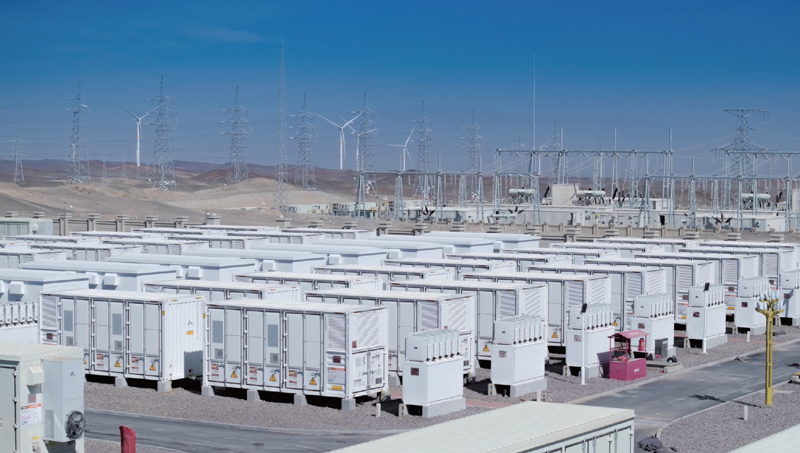
After strict evaluation, the project owner decided to upgrade one-tenth of the Santanghu ESS plant's capacity, that is, 25 MW/100 MWh, to the grid-forming ESS technology. The key advantage of this decision is the ability to reuse the existing civil engineering foundation, ensuring the project meets its grid-connection target by year-end, with a highly controllable construction timeline. The project successfully passed unit-level, site-level, and system-level tests, completing the world's first 100 MWh-level Smart String Grid-Forming ESS testing. This included evaluations under high- and low-voltage disturbances, phase angle jumps, low-frequency oscillations, damping performance, and seamless switching between grid-following and grid-forming modes (covering 10 categories, 55 subcategories, and 826 test applications). These tests verified the system's stable operation and support capabilities under both transient and steady-state conditions, marking a significant milestone for the first utility-scale grid-forming ESS. Another first was the Smart String Grid-Forming ESS black start, which showed a much shorter start-up time than conventional solutions, taking just minutes instead of hours or even days.
As a 100 MWh-level Smart String Grid-Forming ESS, the system replicates all the key characteristics of synchronous generators. The Santanghu 25 MW/100 MWh grid-forming ESS in Hami has been successfully connected to the power grid, playing a key role in facilitating the large-scale integration of renewable energy plants into weak power grids.
The Santanghu project marks the industry's first utility-scale demonstration of grid-forming ESS, driving technological innovation while reducing wind power curtailment and enhancing power generation efficiency. By shifting the system from grid-following to grid-forming, it plays a vital role in developing new power systems where renewable energy serves as the primary energy source.
The success of this project also indicates that CR Power and Huawei Digital Power have reached key milestones in using grid-forming ESS technology to enhance the grid-connection performance of renewable energy plants and accelerate the development of new power systems that rely on renewable energy. It also establishes a strong foundation for future research and testing. In addition, grid forming has been recognized as an essential component for building the next generation of power systems.
Looking ahead, CR Power and Huawei Digital Power will continue working on innovative solutions with world-leading grid-forming ESS technology. They will accelerate the development of clean, low-carbon, safe, and efficient new power systems and contribute to the renewable energy industry.